Tranquillum House’s unauthorized psychedelic session
Nine Perfect StrangersTranquillum House’s unauthorized psychedelic session turns a wellness retreat into an experiment imposed on its guests: Masha discloses that their final smoothie contains LSD and psilocybin only after Heather asks whether they have been medicated. The session brings vivid, emotionally charged encounters and disclosures, yet its promised transformation is inseparable from the guests’ lack of informed choice. The episode makes that conflict concrete: an experience may feel meaningful to those who undergo it while remaining ethically compromised by the way it was arranged.
From retreat routine to concealed drugging
The session arrives within a tightly managed program of fasting, meditation, and silence. Guests are instructed to heed a five-minute warning bell before meals or smoothies, and the rules include no room service during fasting periods. Masha has also introduced the retreat’s first period of silence, which she regards as a way to unsettle guests and establish a new tone. The routines make food and drink part of the institution’s schedule, giving the staff control over when smoothies arrive and what the guests know about them.
Masha initially describes micro-dosing as an aid to the retreat’s existing practices. She claims that small doses can improve creativity, focus, spiritual awareness, and relationships, and says the doses are about one-tenth of a normal LSD dose. She also presents them as a way to help guests focus on yoga and meditation and to ease withdrawal from alcohol and sugar. This explanation frames the drug as a quiet enhancement to an ostensibly voluntary health program, not as preparation for a substantial psychedelic experience.
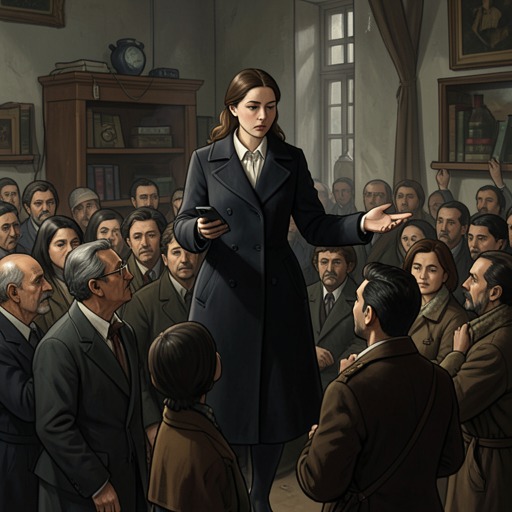
Heather recognizes that the effects now emerging in the group cannot be explained by micro-dosing alone. She points to the last smoothie as different, and Masha confirms that the guests are entering a new protocol. Masha calls it rigorously planned, unprecedented at Tranquillum House, and an extraordinary opportunity for the first nine guests to receive it. She then reveals that most of them have consumed a dose of LSD together with liquid psilocybin, a substance found in certain mushrooms. The announcement comes after administration, not before it; the guests were not asked to consent to this escalation.
Masha’s justification and the breach of consent
The disclosure exposes the divide between Masha’s language of care and her control over the guests’ choices. She portrays psychedelic drugs as having minimal side effects and invokes positive results from clinical trials. In her account, the drugs support the retreat’s practices and reduce the discomfort of giving up substances she considers more dangerous. But these claims do not resolve the immediate question raised by Heather: the guests are experiencing effects beyond the micro-dose Masha first described, and no one gave them the opportunity to decide whether to take the stronger combination.
Delilah’s view clarifies that the absence of consent is not a misunderstanding or an incidental failure of procedure. She recalls Masha’s reasoning: asking permission would be too risky because those most in need of help would be most likely to refuse. Masha believes that the transformation she expects to produce will justify the means, and that once guests experience it they will not complain. The logic converts refusal from a right into an obstacle to treatment. Her confidence in the outcome replaces the guests’ authority to decide what happens to their own bodies.
The episode’s institutional setting sharpens the imbalance. Masha controls the protocol, while Yao and Delilah are involved in the retreat’s operation; the guests receive the disclosure only after drinking the smoothie. The novel therefore distinguishes the claimed therapeutic value of an altered state from the legitimacy of inducing it. The possibility that a participant may later find meaning in an experience cannot retroactively supply the permission withheld at the outset.
The altered experience and its meanings
The guests do not undergo one uniform response. Before Heather’s question, Masha watches their inhibitions fall and their speech become more fluid: Napoleon fidgets, Frances sits very still, and some guests flush while others turn pale. These differences make the group session legible through individual bodies rather than as an abstract promise of spiritual improvement. The same protocol produces varied outward reactions, even as the guests share a room and a drugged drink.
Lars experiences a moment of emotional clarity centered on Ray. The thought that Ray wants only his love seems, briefly, to contain the answer to every question; then Lars’s consciousness breaks into an image of a billion purple petals. The shift joins a specific relational insight to a striking alteration in perception. It records what the experience feels like to him, but it does not establish that the drug has delivered a universally reliable therapeutic result.
The session also creates a setting in which the Marconi family can imagine Zach present with them. Zoe says that Zach would have found it hilarious that the family was getting high together, and Napoleon answers as though his son were there. In that moment, seeing Zach in front of him feels ordinary to Napoleon, restoring the sense of the four family members simply being together. The vision gives grief a temporary scene of reunion, while remaining an experience produced during the psychedelic session rather than evidence that Zach has literally returned.
Frances later recalls a vivid sequence that seemed to encompass Gillian, her father, and her former husbands, along with symbols and visual metaphors she hopes to interpret. She remembers being in space and being an ant. During the experience, Yao, Delilah, and Masha sometimes interrupted with questions and attempts to steer her; Frances ignored them because she was enjoying the visions, and she sensed that they eventually gave up. Her account shows both the imaginative range of the session and the staff’s effort to direct it toward therapeutic ends.
Zoe describes her own experience in terms of a change in her relationship to Zach. She says that she had been angry with him and unable to forgive him, feeling that he had acted deliberately to make her suffer. During the session, however, it felt to her as if they had talked again. Frances compares this sense of contact with her own experience of speaking with Gillian and her father, which felt more vivid than an ordinary dream. Their interpretations give the session personal significance, but the story leaves room between the reality of their feelings and the literal status of the visions.
Aftermath: forced transformation and collective release
Masha’s wider approach to transformation continues to expose the cost of treating the guests as subjects in a plan rather than as people entitled to choose. When the guests are later confined in the studio and fail to find their way out, Yao and Delilah consider letting them out or giving them a clue. Masha refuses, insisting that they must fight their way out like a baby squeezing through a birth canal. Her expectation that struggle will produce rebirth echoes her defence of the psychedelic protocol: in both cases, she imposes an ordeal because she believes the result will justify it.
The retreat’s pressure eventually gives way to a communal return to ordinary pleasures. After the guests reconnect with the outside world, they find wine and food; Jessica grills steaks, Tony twirls pizza dough, and Frances helps in the kitchen. Carmel’s cake draws praise, while some guests dance and others cry. The scene supplies a social aftermath to the controlled routines and imposed experience: people eat, choose their music, and respond in different ways. It does not erase the violation that preceded it, but it contrasts Masha’s managed program with a gathering whose pleasures are shared rather than prescribed.
Narrative significance
The session is a decisive test of the retreat’s central promise that planned discomfort can produce personal change. Masha’s methods are organized around the belief that she can identify what guests need better than they can, and that successful transformation will vindicate her decisions. Yet the guests’ experiences are particular and difficult to reduce to her protocol: Lars thinks of Ray, Napoleon and Zoe imagine a family reunion with Zach, and Frances revisits figures and memories from her life. Their accounts make the emotional force of the session visible without proving Masha’s claims about its efficacy.
That tension is the episode’s ethical and narrative core. Psychedelic experience may rearrange perception, loosen speech, and give grief or love a newly vivid form; none of those effects changes the fact that the guests were not told what they were about to take. By placing meaningful visions beside an explicit breach of consent, the story refuses to make transformation itself an adequate defence. The session can matter to the guests and still remain an act imposed on them.